
What Is the Role of a Support Worker in Daily Living Assistance?
- August 6, 2026
|
Connect Support Group: Qualified, Caring Support Workers in Victoria Registered NDIS provider. Multilingual. No out-of-pocket costs. Call (03) 9874 8628. |
What Does a Support Worker Do?
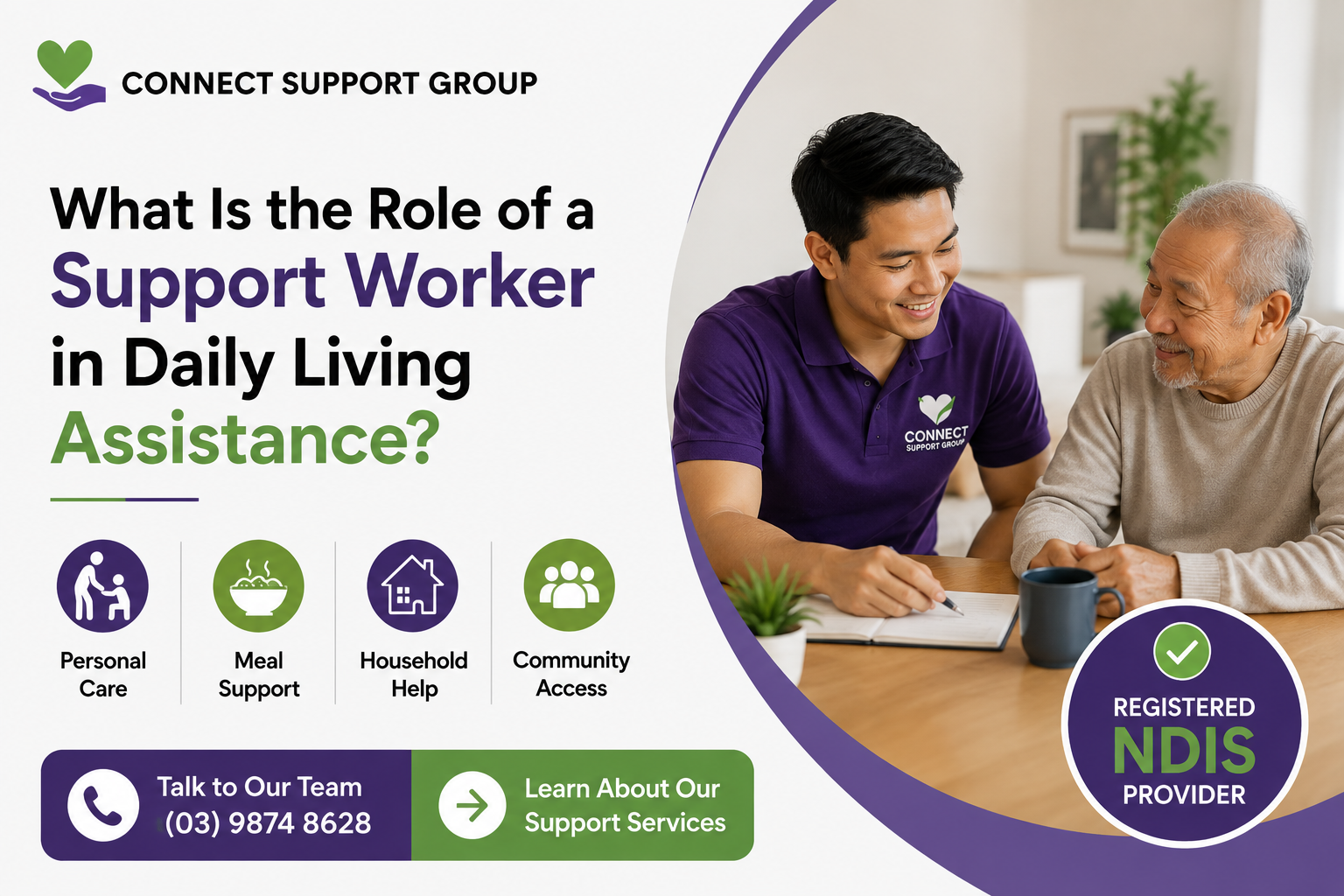
A support worker in a daily living assistance role helps a participant with disability with the practical tasks of daily life that their disability makes difficult or impossible without assistance. The specific tasks are defined by the participant’s NDIS plan and their individual goals and support needs.Personal care and hygiene
For participants who need physical assistance with personal hygiene, a support worker provides help with showering, bathing, grooming, skin care, oral hygiene, and dressing. This support is delivered with sensitivity to the participant’s dignity and personal preferences, recognising that personal care is an intimate activity that requires trust and discretion.Meal preparation and nutrition
Support workers assist with meal planning, grocery shopping, and preparing meals that meet the participant’s dietary requirements and personal preferences. For participants who are building skills toward greater independence, a support worker may work alongside them in the kitchen rather than simply preparing meals for them, supporting the development of cooking skills as a goal in the NDIS plan.Household tasks
Assistance with household tasks including cleaning, laundry, and home organisation forms part of many daily living support arrangements. Support with household tasks ensures that participants can live in a clean, safe, and functional home environment regardless of the physical or cognitive limitations that their disability creates.Community access and transport
Getting to appointments, community activities, day programmes, and social events is part of a full life, and disability should not prevent participation in the community. Support workers at Connect Support Group assist participants with transport to and from appointments, support community access and participation, and help participants build the social connections that contribute to wellbeing.Skill building and independence
For many participants, daily living support is not only about doing things for the person: it is about building their capacity to do things for themselves over time. A skilled support worker identifies opportunities to support the development of new skills, encourages the participant to attempt tasks with support rather than having them done entirely by someone else, and celebrates progress toward greater independence.What a Support Worker Does Not Do
It is important to understand the boundaries of a support worker’s role, both to set appropriate expectations and to recognise when other professionals are needed:- Medical care: support workers are not nurses or healthcare professionals. They do not administer medications (except in specific circumstances with appropriate training and documentation), conduct clinical assessments, or provide medical treatment. When a participant needs clinical care, they need a healthcare professional
- Allied health services: occupational therapy, physiotherapy, speech pathology, psychology, and other allied health services are provided by qualified allied health professionals, not by support workers. Connect Support Group’s occupational therapy service is provided by qualified OTs as a separate service to daily living support
- Legal or financial advice: support workers assist with practical daily living tasks. Legal, financial, or advocacy matters require qualified professionals with appropriate expertise
Qualities of an Effective Support Worker
The relationship between a support worker and a participant is one of the most significant professional relationships in a participant’s life. The qualities that make a support worker effective go beyond technical task completion:- Reliability: showing up when expected and communicating promptly when plans need to change is the foundation of trust in a support relationship
- Respect for dignity and autonomy: a good support worker recognises that the person they are assisting has the right to make their own decisions about their life and that the support worker’s role is to enable those decisions, not to substitute their own judgment for the participant’s
- Cultural awareness: supporting participants from diverse cultural backgrounds requires sensitivity to cultural practices, communication preferences, and family dynamics. Connect Support Group’s multilingual team provides support in English, Mandarin, and Cantonese to ensure cultural comfort for participants from these backgrounds
- Communication skills: effective support workers communicate clearly with participants, families, and the support coordination team, and document support delivery accurately and consistently
- NDIS Worker Screening compliance: all support workers in Victoria must hold a valid NDIS Worker Screening Check, which verifies that they are suitable to work with people with disability. Connect Support Group ensures that all team members meet this requirement
The Person-Centred Approach at Connect Support Group
Connect Support Group operates on a person-centred model: the participant’s goals, preferences, and individual circumstances are the starting point for how support is delivered, not a standardised service template. Meeting our team provides a sense of who our support workers are and the approach they bring to their work. Support is delivered within the framework of each participant’s NDIS plan, with no out-of-pocket costs for NDIS-funded services. Contact us to discuss how Connect Support Group’s support workers can assist with your specific daily living needs.|
Experienced, Trusted Support Workers in Victoria Connect Support Group. NDIS registered. Person-centred. Multilingual. Vermont VIC. Call (03) 9874 8628. |
Frequently Asked Questions
Can I choose my own support worker?
Yes. Under the NDIS, participants have the right to choose their support providers and, where possible, to have input into who specifically delivers their support. Connect Support Group works with participants to identify the support worker who is the best match for their communication style, support needs, and personal preferences. A good support worker match is fundamental to the quality of the support relationship.
What happens if my support needs change over time?
NDIS plans are reviewed regularly, and support arrangements can be adjusted when a participant's needs change. If your daily living support requirements increase or decrease significantly, these changes should be discussed with your support coordinator (if you have one) and may need to be reflected in a plan review. Connect Support Group's NDIS FAQs provide additional information on plan reviews and changing support needs.
Does Connect Support Group provide overnight or 24-hour support?
The support services Connect Support Group provides are determined by the participant's NDIS plan and individual needs. Contact Connect Support Group to discuss your specific support requirements and the available service options.