
What Is the Process to Access Daily Living Support Through the NDIS?
- August 6, 2026
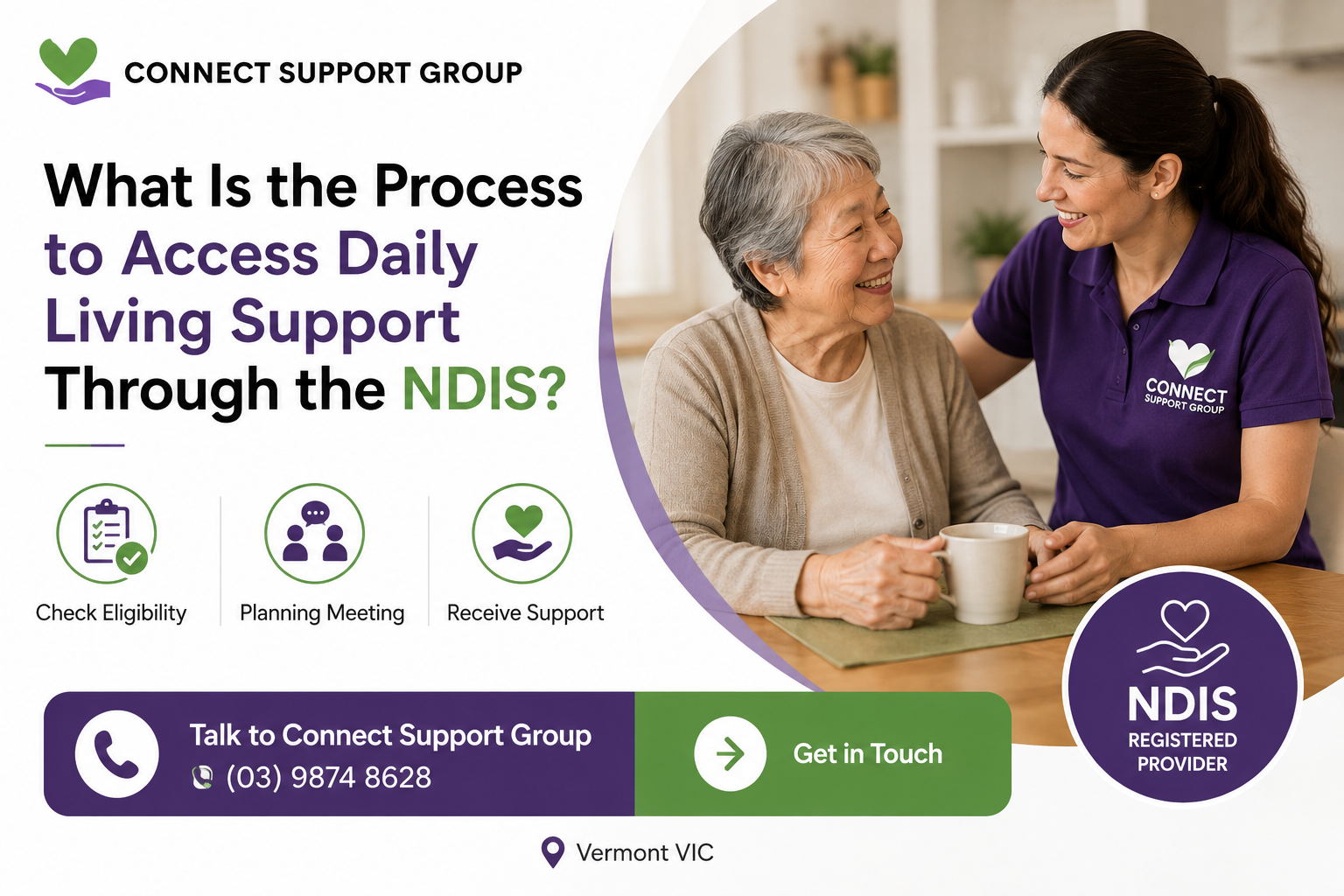
|
Talk to Connect Support Group About NDIS Daily Living Support Registered NDIS provider. Multilingual support. Vermont VIC. Call (03) 9874 8628. |
What Is Daily Living Support Under the NDIS?
Under the NDIS, daily living support falls primarily within the support category known as Assistance with Daily Life (Support Category 3). This category covers the personal assistance and support that participants need to perform daily activities that their disability makes difficult or impossible without help. Examples of what daily living support can include:- Assistance with personal hygiene and grooming
- Help with dressing and undressing
- Support with meal preparation and nutrition management
- Assistance with household tasks such as cleaning and laundry
- Support to get to and from appointments, day programmes, or community activities
- Overnight or 24-hour support where the level of need requires it
- Skill building to support greater independence over time
Step 1: Check Your NDIS Eligibility
NDIS support is available to people who meet three main eligibility criteria: they are under 65 years of age at the time of application; they are an Australian citizen, permanent resident, or protected special category visa holder; and they have a permanent and significant disability that substantially reduces their functional capacity in one or more areas of daily life. The NDIS defines disability broadly and includes physical, intellectual, sensory, cognitive, and psychosocial (mental health-related) disabilities. Early childhood access rules apply for children under seven.Step 2: Make an Access Request to the NDIA
To begin the NDIS process, a person with disability (or their nominee or carer) makes an Access Request to the National Disability Insurance Agency (NDIA). This can be done by calling the NDIA on 1800 800 110, or online through the myplace portal. The NDIA will assess whether the person meets the access criteria, which involves providing supporting evidence about the nature and impact of the disability. This evidence typically includes reports from treating health professionals such as a GP, specialist, occupational therapist, or psychologist.Step 3: The Planning Meeting
Once access to the NDIS is approved, a planning meeting is held between the participant (and their family or carer if desired) and an NDIS planner or Local Area Coordinator (LAC). The purpose of the planning meeting is to understand the participant’s goals, daily life, and support needs, and to develop an NDIS plan that reflects those needs. Preparing for the planning meeting is important. Participants who come to their meeting with a clear picture of their daily support needs, their goals for the future, and their current level of functioning are better positioned to have a plan developed that accurately reflects their requirements.Step 4: Plan Activation and Provider Engagement
Once the NDIS plan is approved, participants can begin engaging support providers to deliver the services in their plan. For Assistance with Daily Life supports, this means contacting registered NDIS providers like Connect Support Group to discuss the types of daily living support that are funded in the plan and how they can be delivered to best meet the participant’s goals. Connect Support Group’s assistance with daily life services are tailored to each participant’s individual plan and goals.| 💡 Support coordination helps you navigate the process: If the NDIS planning process feels complex or you are unsure how to find the right providers, a support coordinator can help. Support coordination is sometimes funded within an NDIS plan and involves a specialist who helps participants implement their plan, connect with providers, and get the most from their NDIS funding. Connect Support Group provides NDIS support coordination services. |
How Connect Support Group Supports NDIS Participants
Connect Support Group is a registered NDIS provider (NDIS PN 4050087037) offering daily living support, support coordination, plan management, social and community access, and occupational therapy in Victoria. Our multilingual team, providing services in English, Mandarin, and Cantonese, ensures that participants from all cultural backgrounds can access support in a language they are comfortable with. Importantly, there are no out-of-pocket costs for eligible NDIS participants: Connect Support Group is paid directly through the NDIS plan, with no gap payments required from participants or their families for NDIS-funded services. Learn more about Connect Support Group’s NDIS services or visit our NDIS FAQs page for answers to common questions.|
Registered NDIS Daily Living Support in Victoria Connect Support Group: multilingual, person-centred, no out-of-pocket costs for NDIS participants. Call (03) 9874 8628. |
Frequently Asked Questions
The NDIA aims to make access decisions within 21 days of receiving a complete access request with all required supporting evidence. Planning meetings are typically scheduled within a few weeks of access approval, though timelines can vary. From initial access request to an active NDIS plan with support in place can take several months in some cases, particularly where additional evidence needs to be gathered or where plans are reviewed. Planning ahead and having supporting documentation ready helps expedite the process.
Yes. Family members, carers, and other nominated supporters can attend the planning meeting and participate in the discussion with the participant's consent. Having knowledgeable and supportive people at the planning meeting who can describe the participant's daily support needs clearly is often beneficial to developing a plan that accurately reflects requirements.
NDIS plans can be reviewed if a participant's circumstances change or if the plan does not adequately meet their support needs. A plan review involves contacting the NDIA and requesting a reassessment. Connect Support Group's support coordination service can assist participants in understanding their plan options and navigating plan review processes.