
How Does Social Support Improve Mental Health in NDIS Participants?
- July 13, 2026
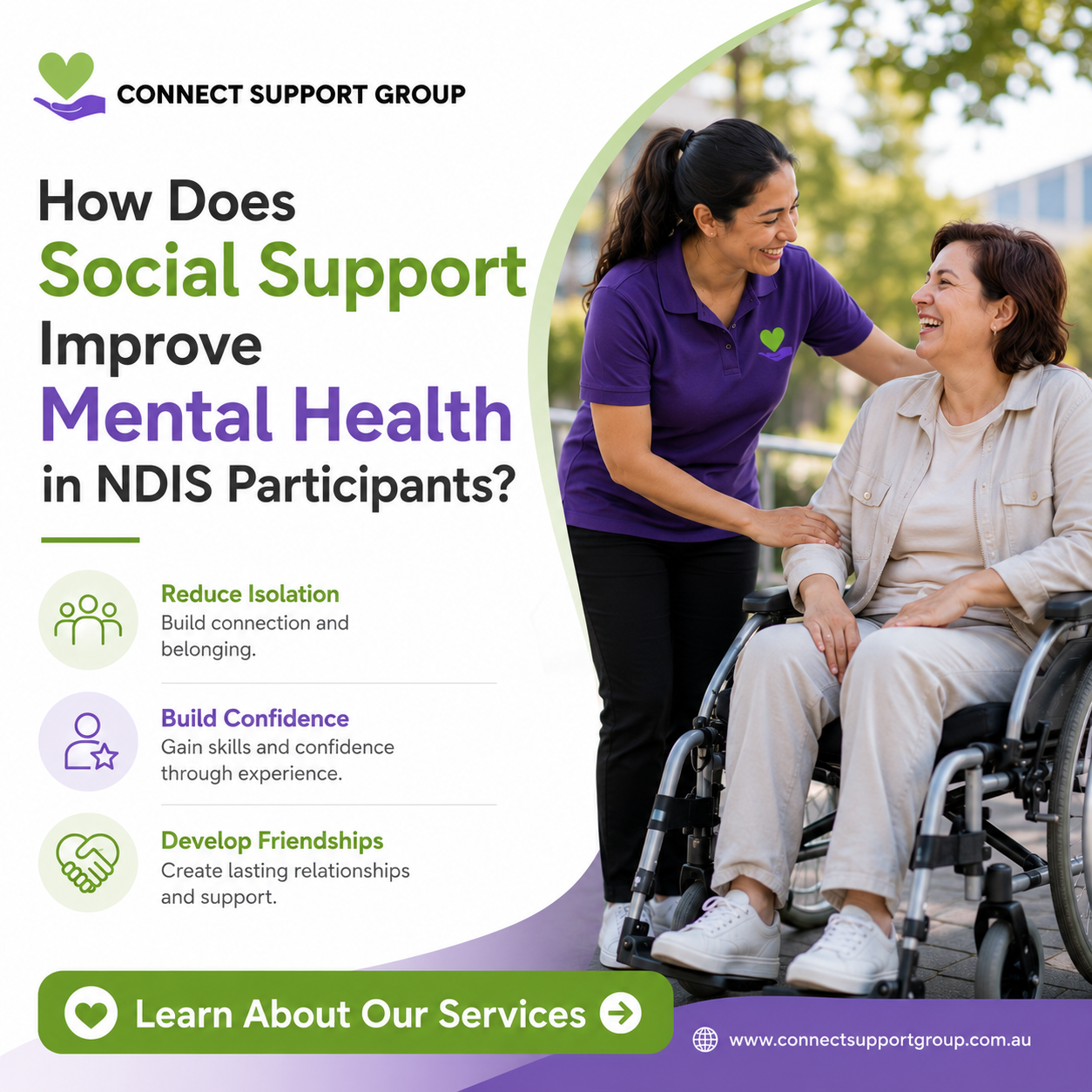
There is a growing body of evidence, and a great deal of lived experience, showing that social connection is one of the most important contributors to human wellbeing. This is not a new insight: it is one of the most consistent findings across decades of research on what makes life feel meaningful, manageable, and worth getting up for in the morning.
For people with disability, the path to social connection can face real practical and structural barriers. But the benefit of overcoming those barriers is proportionally significant. Connect Support Group’s Social and Community Access service is built around the understanding that community participation is not a nice-to-have: it is a meaningful contributor to the health and quality of life of the people we support.
|
Connect with Your Community Through NDIS Social Access Support Connect Support Group provides Social and Community Access support across Victoria. Multilingual team. No out-of-pocket costs. |
Social Isolation and Disability: Understanding the Starting Point
Social isolation is more common among people with disability than in the general population. The reasons are varied and often interconnected: mobility barriers make some venues and activities inaccessible, communication or sensory differences can make certain social settings more challenging, and reduced employment participation means fewer of the incidental social connections that workplaces naturally provide.
Social isolation is not simply an absence of company. It is associated with elevated levels of psychological distress, reduced sense of meaning and purpose, lower self-esteem, and a heightened risk of anxiety and depression. These are not abstract statistical associations: they are the lived experience of many people with disability who find themselves spending week after week without meaningful connection to the broader community.
Understanding the starting point matters because it frames what social support and community access are actually doing. They are not optional extras that improve an already satisfactory quality of life. For many NDIS participants, they are fundamental to maintaining mental health and a sense of purpose.
Reducing Isolation: The Immediate Wellbeing Benefit
The most direct mental health benefit of regular social participation for NDIS participants is the reduction of isolation and loneliness. When a person consistently participates in community activities, the cumulative effect on their day-to-day mental state is often significant.
This does not require a rich or complex social life to produce a benefit. Research on human wellbeing consistently finds that even modest, regular social contact produces measurable improvements in mood and outlook compared to prolonged isolation. A weekly community group, a regular cooking class, or a fortnightly social outing provides a reliable rhythm of social contact that anchors the week and gives each participant something to look forward to.
The sense of anticipation itself has value. Knowing that Thursday involves going to the garden group, and that familiar faces will be there, contributes to a sense of continuity and belonging that has real mood effects. Connect Support Group’s participants regularly report that the activities they access through Social and Community Access support are a highlight of their week, and that the effects on their mood and outlook extend well beyond the activity itself.
Building Confidence Through Regular Community Engagement
Confidence is a skill that is built through practice, not simply acquired. For NDIS participants who have experienced social barriers or who have had limited community participation, the first few community access activities can feel uncertain and uncomfortable.
What consistent community participation does, over time, is build a kind of social confidence through repeated successful experience. Each interaction that goes well, each activity that is enjoyed, each familiar face in a regular group adds to a growing sense of competence and comfort in social settings.
This confidence transfer is real and meaningful. Participants who gain confidence in one social context often report that this generalises outward: they feel more comfortable asking questions at a medical appointment, more confident using public transport, more at ease in an unfamiliar environment. The social confidence developed through supported community activities is not contained to those specific activities.
For participants with anxiety or with histories of difficult social experiences, this gradual, supported approach to community engagement is particularly valuable. The presence of a familiar support worker, in a familiar environment, creates a framework of safety within which confidence can be built progressively.
Developing Friendships: The Deeper Social Connection
Regular participation in community activities creates the conditions for friendships to develop, and genuine friendships are one of the most protective factors for mental health that humans experience across the lifespan.
Friendships among NDIS participants in shared activities develop in the same way that friendships develop in any context: through repeated contact, shared experience, accumulated familiarity, and the gradual discovery of common ground. A participant who attends a weekly art group will, over time, develop a relationship with others in that group that is qualitatively different from the relationship they had with those same people in the first week.
These friendships matter for several reasons:
- They provide a sense of being known: to have people in your life who remember your name, ask how you have been, and notice when you are not there is one of the most basic human social needs, and one that isolation denies
- They create reciprocal care: friendships involve giving as well as receiving. The ability to offer support, encouragement, or simply company to another person is deeply meaningful and counters the one-directional dynamic that can sometimes feel inherent in disability support
- They extend beyond the activity: friendships begun in a community group often extend beyond it. Messages, phone calls, and informal catch-ups that develop from activity-based friendships create a wider social network that has protective effects on mental health beyond the formal support setting
| 💙 Consistency is what builds connection: The social and mental health benefits of community participation build over time, not from a single activity. Consistent, regular participation in the same activities with the same people is what creates the familiarity that allows friendship and genuine connection to develop. A fortnightly group attended for three months creates very different relationships from three one-off visits to different settings. |
The Role of Meaningful Activity in Mental Wellbeing
It is not only the social contact in community activities that benefits mental health: it is also the sense of engagement, purpose, and accomplishment that meaningful activity provides. Occupational therapists recognise this principle as foundational to human wellbeing: people are healthiest when they are engaged in activities that are meaningful to them.
For NDIS participants whose daily lives may have limited opportunities for meaningful occupation, community activities provide this engagement. Whether the activity is creative (art, music, gardening), physical (walking groups, swimming, sport), educational (cooking classes, literacy programmes), or social (friendship groups, café outings), the engagement with a purposeful activity contributes to a sense of vitality and direction.
This is why the NDIS Social and Community Access support category is not simply about providing transport or accompaniment to activities: it is about enabling participation in the kinds of meaningful occupations that contribute to a flourishing life. The support worker’s role is to make that participation possible and to facilitate the engagement that produces the wellbeing benefit.
What the Evidence Tells Us
The evidence on social connection and mental health is consistent and robust across a wide range of populations and research methodologies. Key findings that are directly relevant to NDIS participants include:
- Social isolation is a recognised risk factor for depression, anxiety, and psychological distress across age groups and disability types
- Regular social participation is associated with better mood regulation, lower stress, and improved psychological resilience
- The quality of social relationships matters: superficial contact has a smaller effect than interactions in which participants feel genuinely seen and valued
- Community participation supports self-determination and a sense of agency, both of which are protective for mental health
- For people with disability specifically, community inclusion is associated with greater life satisfaction, higher self-esteem, and a stronger sense of identity beyond the disability
These findings do not suggest that social support replaces professional mental health care for those who need it. Rather, they point to community connection as a foundational element of mental wellbeing that works alongside other supports to create a healthier overall picture.
How Connect Support Group Supports This
At Connect Support Group, we believe that community participation is one of the most important investments a person can make in their own wellbeing. Our Social and Community Access support is delivered by a team that understands the relational dimension of what we do: our role is not only to get participants to activities, but to help them participate, connect, and feel genuinely included.
We work with participants across Victoria and offer services in English, Mandarin, and Cantonese, which means language is not a barrier to accessing or engaging with our support. All services are funded through an approved NDIS plan with no out-of-pocket costs. If you are interested in understanding how Social and Community Access support could work for you or someone you care for, contact Connect Support Group or learn more about how we can support you.
|
Support a Flourishing Social Life with Connect Support Group NDIS Social and Community Access. Victoria-wide. English, Mandarin, and Cantonese. Call (03) 9874 8628. |
Frequently Asked Questions
Social and Community Access is funded under the Core Supports budget in an NDIS plan, specifically under Assistance with Social, Economic and Community Participation. It funds support for participants to attend community activities, social groups, recreational programmes, and other community settings. A support worker may accompany the participant to provide assistance, facilitation, or personal care support as needed during the activity. Connect Support Group's Social and Community Access page explains more about how this support is delivered.
The benefits of regular community participation on mood and mental wellbeing can begin to be felt relatively quickly: many participants notice improved mood and something to look forward to within the first few weeks of regular participation. The deeper benefits, including genuine friendship development, increased social confidence, and a sustained sense of belonging, build over a longer period of consistent engagement. This is why we encourage participants to commit to regular, ongoing participation rather than occasional one-off activities.
Yes. Supported community participation, where a trusted support worker provides a framework of safety and familiarity, is one of the most effective ways to gradually build social confidence for people who experience anxiety in social settings. The graduated exposure to social environments, in a supported and predictable context, helps to reduce anxiety responses over time and build the confidence that comes from successful social experience. Contact Connect Support Group to discuss how Social and Community Access support can be tailored to your specific situation.