
How Does Social Support Improve Mental Health in NDIS Participants?
- October 22, 2026
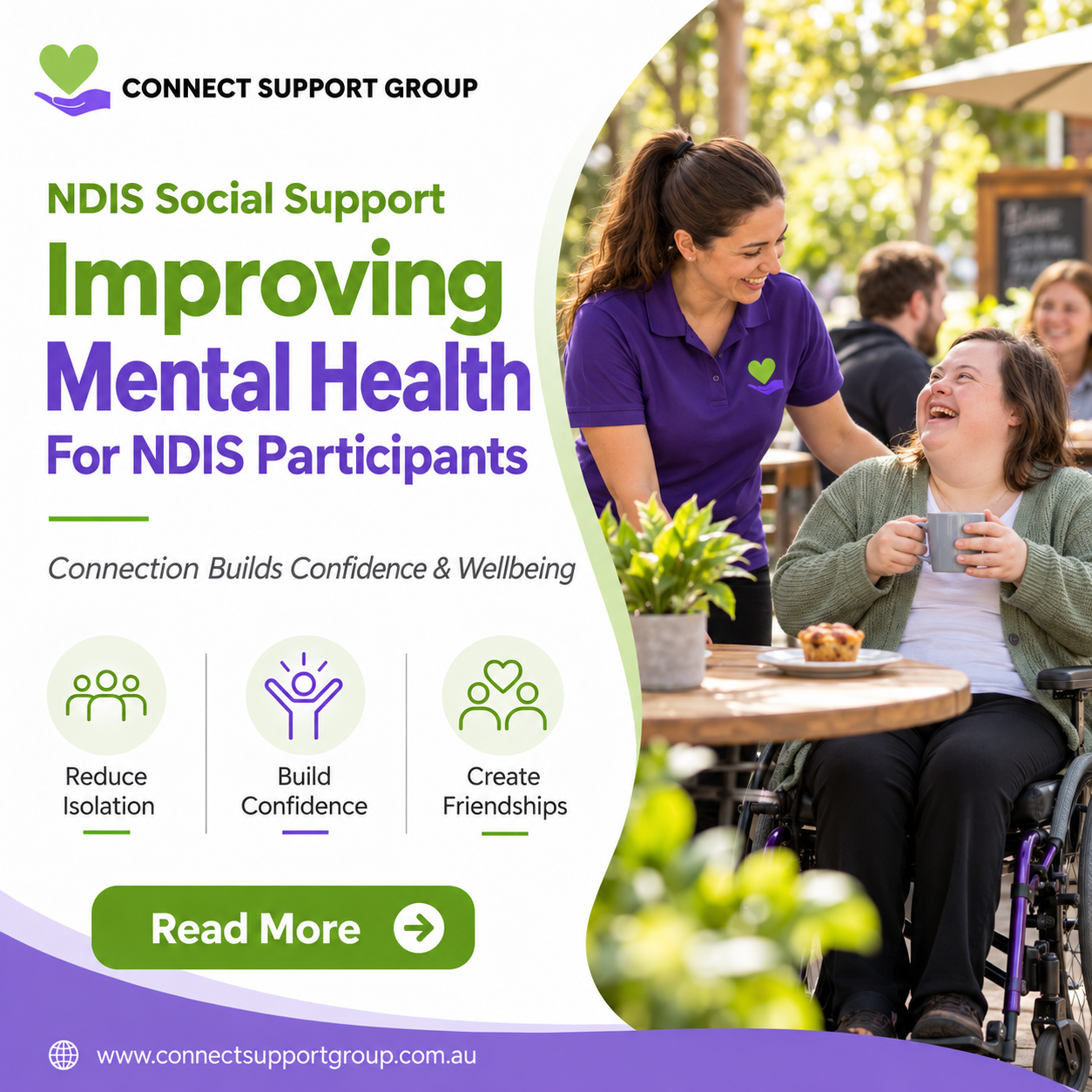
Regular social support can improve mental wellbeing for NDIS participants in four connected ways: it eases isolation and loneliness, gives the week a steady rhythm, builds confidence one experience at a time, and creates the conditions for real friendships to grow. That matters because people with disability are more likely than other Australians to experience social isolation and loneliness, and the Australian Institute of Health and Welfare (AIHW) notes that isolation and loneliness can harm both mental and physical health. Support to take part in community life is one of the ways the NDIS helps reduce the disability-related barriers that keep people at home. It is not a replacement for mental health treatment, but for many participants it is an important part of feeling well.
This guide is for participants, and for the families and carers who support them. It explains why connection matters, what the NDIS can and cannot fund, and how to build social connection into your plan in a way that suits you.
Why does social connection matter for mental health?
It helps to separate two ideas that are often used as if they mean the same thing. The AIHW describes social isolation as a lack of contact with other people, and loneliness as the feeling of being alone. They overlap, but not completely. Someone can see people every day and still feel lonely, and someone else can spend a lot of time alone and feel content.
Both matter for wellbeing. The AIHW links social isolation with emotional distress and poorer mental health, and notes that more frequent social contact is associated with better overall health. It also makes an important point: not all contact is good contact. Relationships that are respectful and freely chosen are what make the difference, which is why good social support is built around a person’s own interests and pace rather than simply filling the diary.
Why are people with disability more likely to feel isolated?
The AIHW reports that people with disability are more likely to experience social isolation and loneliness than Australians without disability. The reasons usually have more to do with the world around a person than with the person themselves:
- venues, footpaths and activities that are not physically accessible
- transport that is difficult or impossible to use without help
- noisy, crowded or unpredictable environments that are hard to manage
- fewer of the everyday connections that come with work or study
- attitudes and assumptions from other people that make social settings feel unwelcoming
- language barriers, for people who are more comfortable in a language other than English
Research summarised by the Australian Institute of Family Studies also identifies carers, and people from migrant or non-English speaking backgrounds, as more likely to report problems with loneliness or social isolation. In some households these factors overlap, so a participant, their carer and the wider family may all be affected at once.
Seeing isolation as a set of barriers is useful, because barriers can be worked on. That is exactly what support to take part in community life is designed to do.
How does regular community interaction reduce isolation?
The most immediate benefit of social support is simple: it gets people out and among others on a regular basis. A support worker who helps you get to the local library, a walking group or a weekly cooking class removes one of the barriers that might otherwise keep you at home.
Regularity matters as much as the activity itself. A standing weekly commitment gives the week shape and something to look forward to. Seeing the same faces in the same place builds familiarity, and familiarity is where a sense of belonging starts. Being recognised, having someone ask how your week has been, and knowing people would notice if you were not there are small things, but they add up.
Transport is often the deciding factor. If getting there is the hardest part, read our guide on whether the NDIS can pay for transport to community activities.
How does social support build confidence?
Confidence tends to grow from experience rather than from encouragement alone. Each outing that goes well, each conversation that feels a little easier and each new place that becomes familiar gives a person more evidence that they can manage.
Good social support is paced. For someone who has been isolated for a long time, or who finds social situations stressful, a first step might be a short visit to a quiet café with a familiar support worker. Over time that might become a longer outing, a small group activity, or a trip taken with less support. The participant stays in charge of the pace, the activities and how much support they want, which is at the heart of choice and control under the NDIS.
The principles in the NDIS Act recognise that participants should be supported to make their own choices, including taking reasonable risks to pursue their goals. Trying something new always carries some uncertainty. A support worker’s role is to make that uncertainty manageable, not to remove every challenge.
Many of the skills built along the way are practical ones: ordering and paying at a counter, catching a bus, finding your way around a shopping centre, or introducing yourself in a group. These skills carry into other parts of life, which is why community participation can support independence as well as wellbeing.
How do friendships develop through community participation?
Friendships rarely form in a single meeting. They grow from repeated contact with the same people, doing something you both enjoy, over weeks and months. Group activities built around a shared interest, such as art, cooking, gardening, sport or a regular social outing, create exactly those conditions.
The NDIA’s idea of an ordinary life, developed with advice from the NDIS Independent Advisory Council, includes positive relationships, a sense of belonging to friendship networks and communities, and active involvement in community life. Friendships are part of that picture, not an optional extra.
It is worth being honest about one thing. A good support worker is warm, friendly and interested in you, but the relationship is a professional one. Part of their job is to help you build connections with other people, so that your social life does not depend on paid support alone. Friendships that involve giving as well as receiving, whether that is volunteering, helping another group member or sharing a skill, can be especially meaningful.
What can the NDIS fund to support social connection?
Every support has to meet the NDIS reasonable and necessary criteria, and what is included depends on your individual plan. Supports that commonly help with social connection include:
- Support to take part in community activities: a support worker who helps you get to, and take part in, activities and groups, either one to one or in a small group. This is often called social and community access, and is funded under Assistance with Social, Economic and Community Participation in the core supports part of a plan.
- Transport: where your disability means you cannot use public transport without substantial difficulty.
- Capacity building supports: help to build skills and confidence so you can take part more independently over time.
- Psychosocial recovery coaching: for participants with psychosocial disability, a recovery coach can help build capacity and resilience and work with you to coordinate your supports.
The NDIS generally will not fund:
- the cost of the activity itself, such as event tickets or a gym membership, which are costs anyone might have
- clinical treatment of a mental health condition, which is the responsibility of the health and mental health systems
That second point is important. Social support and mental health treatment do different jobs. If you are receiving treatment, community participation can sit alongside it and support your wellbeing, but it does not replace the care you get from your GP or mental health professionals.
Connect Support Group’s social and community access service includes one-to-one outings and a group program, Social Saturdays, for meeting other people and building friendships in a group setting.
What does good social support look like?
Not all support works the same way, and the right fit makes a big difference to whether time in the community actually helps. Whichever provider you choose, these are useful things to look for and to ask about.
- It starts with you. A good provider asks about your interests, your goals and what has or has not worked before, and builds activities around your answers.
- It is consistent. Seeing the same support worker, or a small familiar team, makes it easier to relax and build trust, especially at the start.
- It is paced by you. You should be able to start small, slow down on a hard week, and try something bigger when you feel ready.
- It looks outward. Over time, support should help you connect with other people and groups in your community, not only spend time with your worker.
- It fits your language and culture. If you or your family are more comfortable in another language, ask whether support can be provided in that language.
- It keeps the right people informed. With your permission, a provider should be able to keep in touch with family, carers or your support coordinator about how things are going.
It is also fine to change your mind. If an activity is not working for you, a good provider will help you find something else rather than keep booking the same thing. You are always free to change providers if the support is not right for you.
How can you build social connection into your NDIS plan?
The way you describe your goals and your circumstances shapes the supports that can be considered. A few practical suggestions:
- Say what isolation actually looks like for you: how often you leave home, who you see, and what stops you from doing more.
- Write goals in your own words. A goal such as making friends who share your interest in music, or feeling confident going to the local shops, gives a planner something concrete to work with.
- Choose activities that genuinely interest you. Support works when it is built around what you enjoy, not around what fills a timeslot.
- Start small and build up. It is fine for a first goal to be modest.
- Keep a simple record. Notes on what you have tried, what worked and how it felt are useful at your next check-in or plan reassessment.
Our guide on how to set meaningful goals in your NDIS plan has more ideas.
What if language or culture is part of the barrier?
Joining a group where you cannot easily follow the conversation, or where your culture and customs are not understood, can make isolation worse rather than better. Support delivered in your own language, by people who understand your background, can make the first step much easier for both the participant and their family.
Connect Support Group’s team includes staff fluent in Mandarin and Cantonese as well as English. Find out about our NDIS services in Mandarin and Cantonese. If you need an interpreter to speak with the NDIA or another service, you can contact the Translating and Interpreting Service (TIS National) on 131 450.
What about carers and families?
Carers are also more likely to report loneliness and isolation, and caring for someone who is isolated can be tiring and worrying. When a participant has regular, reliable social support, family members may also gain time for their own rest, work and relationships. Looking after your own wellbeing is part of sustaining care over the long term, and our article on self-care for carers has practical ideas.
When is social support not enough?
Social connection supports wellbeing, but it cannot fix everything, and it is not a substitute for professional help. If you or someone you support is feeling persistently low or anxious, or is not like themselves, talk to a GP, who can discuss options for mental health care.
If you are in crisis or worried about your immediate safety, call 000. For 24-hour crisis support, call Lifeline on 13 11 14. For support with anxiety or depression, contact Beyond Blue on 1300 22 4636.
Frequently asked questions about social support and mental health
Can the NDIS fund social activities to support mental health?
The NDIS can fund disability-related support to help you take part in social and community activities, such as a support worker, where it meets the reasonable and necessary criteria. It does not fund clinical mental health treatment, and the cost of the activity itself is usually yours to pay.
Do I need a psychosocial disability to get social and community access support?
No. Support to take part in community life can be included in the plans of participants with many types of disability, where it relates to their disability support needs and meets the reasonable and necessary criteria.
How often should I take part in community activities?
There is no right number. What matters is a regular rhythm that suits your energy, interests and goals. A regular weekly commitment can be easier to keep than occasional one-off outings, because it becomes part of your routine.
Is a support worker the same as a friend?
No. A good support worker should be friendly and genuinely interested in you, but the relationship is professional. Part of their role is helping you build friendships and connections with other people.
Take the next step toward connection
If you would like to talk about social and community access support for yourself or someone you care for, the Connect Support Group team is here to help. We are based in Vermont in Melbourne’s east, and our team speaks English, Mandarin and Cantonese. Call (03) 9874 8628 or send us an enquiry online. You are always free to choose the providers that are right for you.