
Can my support coordinator help me change providers?
- September 10, 2026
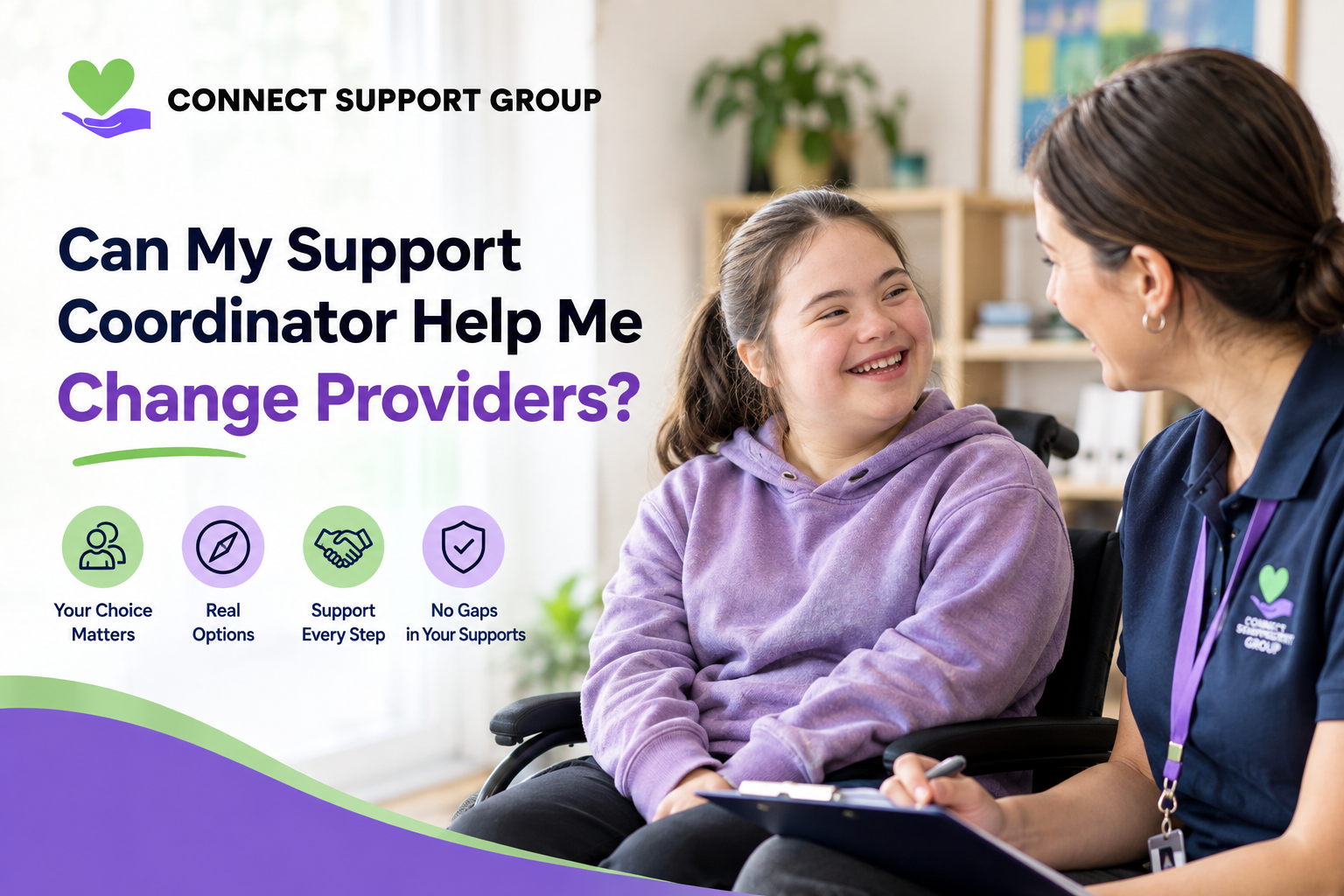
You are allowed to change providers
Choice and control is not a slogan in the NDIS, it is the design of the scheme. You choose your providers, and you can change them. You do not have to wait for your plan to be reassessed. You do not need approval from the NDIA. You do not need your provider to agree. The reasons people change are ordinary ones. The support worker is not the right fit. Availability has dropped off. The service has changed and no longer suits. Your goals have moved on. You have found someone closer to home or someone who speaks your language. Or the relationship has simply run its course. None of these need explaining to anyone.What your support coordinator can do
- Talk through what is not working, and whether the current provider could fix it.
- Help you raise the issue with your current provider if you would rather not do it alone.
- Read your service agreement with you and tell you what notice you need to give.
- Research alternatives and give you a genuine range of options to choose from.
- Check which of those providers actually has capacity right now.
- Set up meetings so you can talk to a new provider before committing.
- Help you understand a new service agreement before you sign it.
- Time the change so your new supports start before the old ones stop.
- Update your plan manager, and make sure the records with the NDIA are correct.
- Follow up afterwards to check the new arrangement is working.
What your support coordinator cannot do
- Make the decision for you. They can lay out the options. The choice is yours.
- Sign a service agreement on your behalf. That is your signature or your nominee’s.
- Stop you from leaving a provider, including one connected to their own organisation.
- Restrict you to a shortlist made up only of their own organisation’s services.
- Charge you a fee to help you change. This is coordination work, paid from your existing coordination budget.
- Approve funding. Only the NDIA can do that.
The steps for changing providers
The NDIA sets out five steps. Your coordinator can help with all of them.Step 1: Talk to your provider
If you are unhappy with the support you are getting, you can talk to your current provider first and ask for changes. Sometimes that fixes it, and it is usually less disruptive than starting again. You can ask your my NDIS contact, your support coordinator or a trusted person to help you have that conversation. If you do not feel comfortable talking to your provider, or you are unhappy with the way they speak to you, you can go to the NDIS Quality and Safeguards Commission instead. You do not have to have the conversation.Step 2: Check your service agreement
Your service agreement tells you how many days’ notice you need to give. This is sometimes called a notice period or a cancellation period. Different supports can have different notice periods, so check each agreement rather than assuming they match. Look for fees as well. You may be charged if you end the agreement without giving the notice you agreed to. The NDIS pricing arrangements and price limits set the conditions under which providers can claim cancellation fees, so a fee is not automatically allowed just because a provider says it is.Step 3: Find a new provider
Find the new provider before you finish up with the old one. This is the step people get wrong, and it is the one that causes gaps in supports. Your coordinator can research options, use the NDIS provider finder, check who has capacity, and set up meetings so you can meet a provider before you commit. It is a good idea to meet new providers before you start working with them. When you have chosen, get a written service agreement that sets out what you have both agreed to, how long it runs for, and how changes can be made.Step 4: Tell your current provider you are leaving
Ask whether they have a form or a process for ending a service agreement. Put it in writing either way, and keep a copy. Make sure there are no outstanding payments. If you have a support coordinator or a plan manager, tell them you are changing providers.Step 5: Update the participant portal
Depending on which system your plan sits in, there is a record to update. If you use the myplace participant portal, check with your provider whether you need to end the service booking or whether they will do it from their side. If you use the my NDIS participant portal, check whether you need to end the my provider relationship or whether the provider will do it. You can update provider relationships yourself in the my NDIS participant portal, and you can accept or decline a new relationship request and choose what information you share. You can also add, change or remove providers at any time by talking to your my NDIS contact or by calling the NDIA on 1800 800 110.How your plan management affects the change
If you are plan-managed
Your plan manager pays your invoices, so they need to know about the change. Tell them the last date of service with the old provider and the start date with the new one, so nothing is paid in error and nothing gets missed. Make sure any final invoices from the outgoing provider are settled.If you are self-managed
You have the most flexibility. You can use registered or unregistered providers, and you handle the payments and records yourself. Keep the paperwork for both the ending agreement and the new one.If you are NDIA-managed
You need to use providers registered with the NDIS Quality and Safeguards Commission, so check the registration status of any new provider before you commit. The records held by the NDIA also need to be accurate, which is why step five matters.The awkward one: what if I want to leave a provider connected to my coordinator?
This is the situation people find hardest, and it is more common than you might think. Many organisations that provide support coordination also provide other NDIS supports. In a campaign examining support coordination practices, the NDIS Quality and Safeguards Commission found that 71 per cent of providers delivered services in addition to support coordination, either under the same ABN or through an associated entity. So if your coordinator works for an organisation that also provides your daily living support or your therapy, and you want to change that support, you are not in an unusual position. The NDIS Practice Standards address this directly. For specialist support coordination, the standards set an outcome that each participant receives transparent, factual advice about their support options which promotes choice and control. The indicators include that the provider’s conflict of interest policy is explained to you in language you are most likely to understand, that you are supported to understand the difference between support coordination and the other supports in your plan, that you are made aware of any interest the provider has in a support option available to you, and, critically, that you understand any choice you make about providers of other supports will not affect the support coordination you receive. That final point is your protection, and it is worth knowing in plain terms: leaving one service should not cost you the other. If you change your daily living provider, your coordination should continue exactly as before. If you feel that is not what is happening, that is a problem worth raising.How to raise it without a confrontation
- Say it plainly. “I would like to look at other options for my daily living support. Can you give me a few providers to consider?” You do not need to give a reason.
- Ask for the conflict of interest policy if you have not seen it.
- Ask for options that include providers outside their organisation. You are entitled to genuine alternatives.
- If it feels difficult, bring someone with you. A family member, a friend or an advocate.
- Put the request in writing if the conversation goes nowhere. It creates a record.
What if my coordinator is discouraging me?
Some warning signs:- Every option you are offered belongs to their organisation.
- You are told you cannot change until your plan is reassessed. That is not correct.
- You are told changing will affect your funding or your coordination. It should not.
- They will not tell you what notice period applies, or will not show you your own agreement.
- They delay, do not follow up, and the conversation quietly goes away.
- You are made to feel disloyal or ungrateful for asking.
Changing your support coordinator itself
The process is the same as changing any other provider. Check the notice period in your agreement with them. Find a new coordinator first so there is no gap, and meet them before committing. Give written notice to your current coordinator. Make sure the NDIA records are updated, either through the portal or by calling 1800 800 110, and tell your plan manager if you have one. One practical tip: ask your outgoing coordinator for a handover. A summary of your current providers, agreements in place, what has been tried, and where your coordination budget is up to will save your new coordinator weeks of catching up, and that is time paid from your budget. Most coordinators will do this without being asked, but ask anyway.Avoiding a gap in your supports
The single most useful thing you can do is overlap rather than leave a gap. Line up the new provider, agree a start date, and only then give notice to the old one, counting back the notice period from the date you want to finish.- Confirm the new provider’s start date in writing before you give notice.
- Count the notice period backwards from your last day, not forwards from today.
- Check whether any equipment, keys, or documents need to be returned or handed over.
- Ask for a final invoice so nothing surfaces months later.
- Confirm with your plan manager which provider should be paid for which dates.
- Check the portal record has actually been updated after the change.
Frequently asked questions
No. You can change providers at any time and you do not need to justify the decision to your provider, your coordinator or the NDIA.
It depends on your service agreement, which sets the notice period. Different supports can have different notice periods, so check each agreement. You may be charged a fee if you end an agreement without giving the notice you agreed to.
A provider can only claim cancellation charges in line with the NDIS pricing arrangements and price limits, and in line with what your service agreement says. If you are asked for something that does not match either, question it and ask for it in writing.
Changing providers does not change what is in your plan. The funding stays the same. What changes is who delivers the support and who is recorded against it.
The record needs to be accurate, so yes. Depending on which portal your plan uses, either you or the provider ends the old relationship or service booking and sets up the new one. You can also add, change or remove providers by talking to your my NDIS contact or calling 1800 800 110.
Yes. Each service agreement is separate. Changing one provider has no effect on the others unless you choose to change them too.
A provider cannot prevent you from ending a service agreement. If you are being blocked, delayed or pressured, put your notice in writing, keep a copy, and contact the NDIS Quality and Safeguards Commission.
Talk to us
If you are
thinking about changing a provider and want help working out your options, or
you would just like someone to read your service agreement with you, Connect
Support Group can help. We are a registered NDIS provider based in Vermont,
with staff fluent in English, Mandarin and Cantonese.
If you are not
sure whether your current coordination arrangement is working for you, our
guide on choosing a support coordinator sets out the questions worth asking.