
Can the NDIS Pay for Transport to Community Activities?
- July 13, 2026
|
Need Help Understanding Your NDIS Transport Funding? Connect Support Group supports NDIS participants in Vermont and across Victoria. Multilingual team. No out-of-pocket costs. |
How NDIS Transport Funding Works
The NDIS recognises that many people with disability face significant barriers to using public transport and that this affects their ability to participate in community life. Transport funding within the NDIS is designed to address this barrier, not to fund all travel for everyone, but to fund transport that is directly linked to a participant’s disability-related needs. Transport support sits within the Core Supports budget of an NDIS plan, specifically under the Transport subcategory. This is separate from the Assistance with Social, Economic and Community Participation supports, which fund the support worker or other assistance provided once a participant arrives at an activity. The way transport funding is included in a plan varies. For some participants, the NDIS includes a specific transport allowance that can be used flexibly across the week. For others, transport costs are considered as part of the cost of accessing specific supports. The structure of your transport funding will be reflected in your NDIS plan and can be clarified with your Support Coordinator or Plan Manager.Who Is Eligible for NDIS Transport Funding?
The NDIS assesses transport funding as reasonable and necessary based on the impact of a participant’s disability on their ability to travel. Eligibility is not automatic for all NDIS participants: it is assessed based on individual circumstances. The NDIA considers whether:- The participant’s disability significantly affects their ability to use public transport independently
- The participant cannot travel independently without risk to themselves or others
- Public transport is not accessible, available, or safe for the participant given their disability-related needs
- The participant does not have a driver’s licence and cannot drive as a result of their disability
- The transport need is directly related to the participant’s disability and supports their NDIS goals
| 💙 Transport funding is needs-based, not automatic: Not every NDIS participant receives transport funding. It is included in a plan when the NDIA determines it is reasonable and necessary for that person. If you believe you need transport support and it is not in your current plan, your Support Coordinator can help you prepare evidence to request it at your next plan review. |
What Transport Funding Can Be Used For
Once transport funding is included in an NDIS plan, it can be used in a number of ways depending on the participant’s circumstances and how their plan is structured:- Taxis and rideshare: where a participant cannot use public transport due to their disability, NDIS transport funding can be used to cover the cost of a taxi or rideshare service to community activities, appointments, and other plan-related destinations
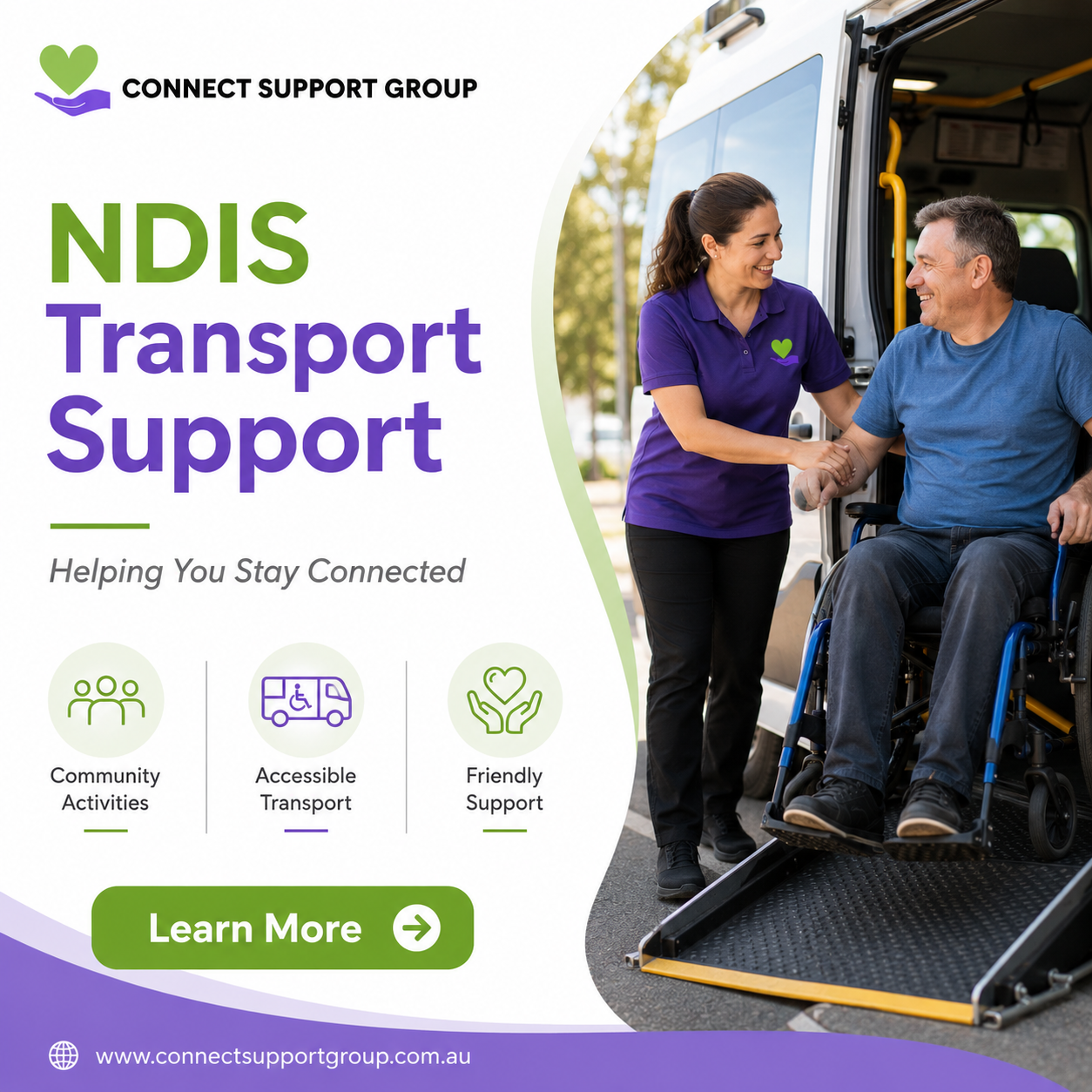
- Accessible vehicle services: transport in an accessible vehicle, where the participant’s disability requires a vehicle equipped with a wheelchair ramp, hoist, or other accessibility equipment
- Support worker travel: where a support worker accompanies a participant to a community activity, the support worker’s travel time and transport costs may be funded as part of the support, not as a separate transport item
- Public transport top-ups: in some circumstances, the cost of public transport (such as fares) may be covered where the participant can use public transport with support but cannot do so independently
The Difference Between General Access Transport and Specialised Transport
One of the most common points of confusion is the difference between general access transport and specialised transport in the NDIS context. These refer to meaningfully different levels of service.General access transport
General access transport covers standard modes of transport (taxis, rideshare, public transport) used by a participant to travel to and from activities that are part of their NDIS plan. It does not require a purpose-built accessible vehicle. A participant who can travel in a standard vehicle but cannot independently arrange, navigate, or use public transport due to their disability may access general transport support. General transport support is the most common form of transport funding in NDIS plans. It is relatively straightforward to use and does not require the commissioning of a specialist vehicle.Specialised transport
Specialised transport refers to transport provided in vehicles specifically equipped for participants with higher support needs, including those who use power wheelchairs, complex wheelchair systems, or who require vehicle-mounted seating or restraint systems. This category of transport typically requires a provider with the appropriate vehicle and driver training. Specialised transport is typically more expensive per trip than general access transport, but it is funded through the NDIS where the participant’s disability-related needs require it. It is not an upgrade in service quality: it is a response to a genuine physical requirement that standard taxis and rideshare vehicles cannot meet.| Factor | General access transport | Specialised transport |
| Vehicle type | Standard taxis, rideshare, or public transport | Purpose-built accessible vehicle with ramp, hoist, etc. |
| Typical participants | Those who can travel in standard vehicles but cannot do so independently | Power wheelchair users or participants requiring specific vehicle equipment |
| Who provides it | Standard taxi/rideshare providers or support workers | Registered disability transport providers |
| Typical cost | Lower per trip | Higher per trip; reflects specialist equipment and training |
| Eligibility | Disability impacts independent travel; no vehicle requirement | Disability requires accessible vehicle equipment |
Transport and Social Community Activities: How It All Connects
For many NDIS participants, transport funding is what makes Social and Community Access support actually possible. It is not enough to have support funded for the activity itself if getting to and from the activity is not also addressed. A participant who has community access support in their plan but no transport support may find that the two pieces cannot work together without a plan review to address the gap. When setting up Social and Community Access support, it is worth clarifying the transport arrangements at the planning stage:- Is transport to the activity funded within the transport subcategory, or as part of the community access support itself?
- Will a support worker accompany the participant on the journey, or will the participant travel independently using funded transport?
- Is the mode of transport (taxi, bus, accessible vehicle) suitable for the participant’s needs?
|
Talk to Connect Support Group About Your NDIS Transport Support We support participants across Victoria in English, Mandarin, and Cantonese. No out-of-pocket costs. Call (03) 9874 8628. |
Frequently Asked Questions
Does every NDIS participant get transport funding?
No. Transport funding is included in an NDIS plan only when the NDIA determines it is reasonable and necessary based on the participant's disability-related needs. Not all participants receive transport funding, and the amount varies based on individual circumstances. If you believe transport funding should be included in your plan and it currently is not, speak with your Support Coordinator or raise it at your plan review. Connect Support Group's Support Coordination service can help you prepare for this conversation.
Can I use my NDIS transport funding to get to a friend's house or medical appointment?
NDIS transport funding is intended for transport that is directly connected to your NDIS goals and disability-related needs. Travel to social activities that are part of your NDIS plan goals can be covered. General medical appointments are typically covered by Medicare rather than the NDIS. Travel to a friend's house that is not part of a structured community access activity would generally not be covered. Your Support Coordinator or Plan Manager can help you understand what is and is not claimable within your specific plan.
Can a family member drive me to activities and be paid for it?
In most circumstances, family members cannot be paid to transport NDIS participants using NDIS funds unless they are a registered support worker and meet the NDIS requirements for this arrangement. There are some specific and limited circumstances where informal or family carer arrangements may be acceptable, but these have specific conditions attached. Contact Connect Support Group or check the current guidelines at ndis.gov.au to understand the conditions that apply in your situation.