
What Levels of Support Coordination Are Available in the NDIS?
- May 11, 2026
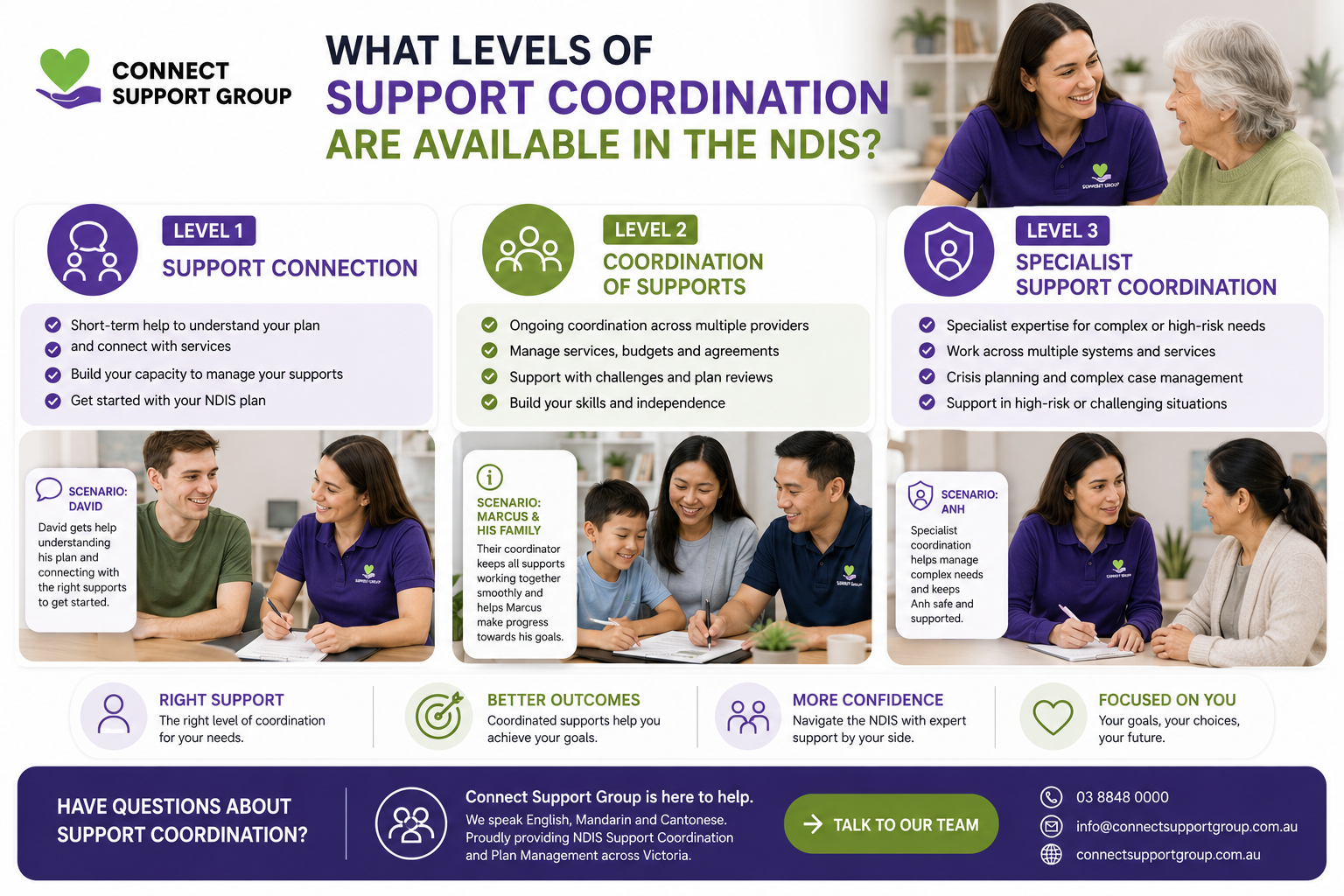
When NDIS participants and families talk about ‘support coordination’, they sometimes use it as a general term for any help navigating the NDIS. But within the NDIS itself, support coordination is a specific funded support — and it comes in three distinct levels, each designed for a different level of need and complexity.
Understanding which level is in your plan (or which level you might need) is important. The level of support coordination you receive determines who provides it, what they’ll actually do with you, and how much planning and coordination capacity you have available.
This article explains all three levels in plain language — what each includes, who they’re for, and what eligibility looks like. If you have questions about your own plan, our team at Connect Support Group is happy to help.
Connect Support Group provides NDIS Support Coordination Our experienced support coordinators work with participants across Victoria to help them make the most of their NDIS plans. No out-of-pocket costs — funded through your plan. |
An Overview of the Three Levels
The NDIS recognises three types of support coordination, ranging from initial assistance through to highly specialised clinical coordination:
| Level | NDIS Name | Funded From | Who It’s For |
| Level 1 | Support Connection | Core Supports | Participants who need short-term help setting up their plan |
| Level 2 | Coordination of Supports | Capacity Building — Support Coordination | Participants who need ongoing help to manage and coordinate their supports |
| Level 3 | Specialist Support Coordination | Capacity Building — Support Coordination | Participants with complex or high-risk support needs requiring specialist expertise |
Each level is described in more detail below, with real-life examples to help you understand what each one looks like in practice.
Level 1: Support Connection
Support Connection is the most basic level of support coordination in the NDIS. It’s designed to help participants understand their plan and start connecting with supports — particularly in the early stages of having a plan, or for participants whose needs are relatively straightforward.
What Support Connection includes
- Helping you understand what your NDIS plan means and what each funding category is for
- Assisting you to identify and connect with appropriate providers and services
- Supporting you to start using your NDIS funding effectively
- Building your capacity to manage your own supports and plan over time
Support Connection is typically a more time-limited support. The intent is to help you get started — not to provide ongoing coordination indefinitely. It’s usually delivered by support workers or coordinators rather than specialists.
Who is Support Connection for?
- Participants who are new to the NDIS and need initial guidance
- Participants with relatively straightforward support needs who don’t require intensive coordination
- Participants who are generally able to manage their own supports but need some initial help setting things up
💬 Scenario — David David is 22 and has recently been approved for the NDIS following a physical injury. His plan is relatively straightforward — he has funding for physiotherapy and some assistance at home. His plan includes Support Connection funding to help him understand his plan, find a suitable physio in his area, and set up a service agreement with a home support worker. Once he’s set up and comfortable, he manages his supports with minimal assistance. |
Level 2: Coordination of Supports
Coordination of Supports is the most commonly allocated level of support coordination in the NDIS, and it’s the primary service offered by Connect Support Group. It goes significantly further than Support Connection — it’s an ongoing, active coordination role that works with you to implement your plan, manage your providers, and keep your supports aligned with your goals and changing needs.
What Coordination of Supports includes
- Thoroughly understanding your NDIS plan and helping you make sense of all your funding categories and goals
- Identifying the right combination of supports and service providers for your individual situation
- Setting up and managing service agreements with all your providers
- Coordinating across multiple providers to make sure everything works together smoothly
- Monitoring your budget and ensuring your funding is used efficiently
- Supporting you through any challenges — for example, if a provider isn’t meeting your needs or if your circumstances change
- Preparing for your NDIS plan review — documenting your progress, identifying new goals, and gathering evidence
- Building your skills and capacity to increasingly manage your own supports over time
The ‘Coordination’ in the name is significant. A coordinator at this level is doing active, ongoing work — not just a one-time setup. They’re your point of contact when things need to change, and your advocate when the system is complicated.
Who is Coordination of Supports for?
- Participants with moderate to complex support needs who require ongoing coordination across multiple providers
- Participants who have a range of different support types (allied health, community access, daily living, etc.) that need to work together
- Participants who are new to the NDIS and need more comprehensive guidance than Support Connection provides
- Families and carers who need a coordinator to work alongside them in managing a child’s or family member’s plan
| ℹ️ Capacity Building: Coordination of Supports is funded from the Capacity Building budget, not Core Supports. This means it has its own funding line in your plan and doesn’t come out of your everyday support funding. |
💬 Scenario — Marcus and his family Marcus is 9 years old and has autism spectrum disorder. His NDIS plan includes speech therapy, occupational therapy, behaviour support, and some community access hours. His support coordinator from Connect Support Group works closely with Marcus’s parents to coordinate all four providers, making sure appointments don’t clash, reviewing Marcus’s progress with each provider, and ensuring the behaviour support plan is being consistently implemented across home and therapy. When Marcus’s speech therapist moves clinics, the coordinator helps find a replacement quickly so there’s no gap in his therapy. Marcus’s parents describe their coordinator as ‘the person who keeps everything together.’ |
Level 3: Specialist Support Coordination
Specialist Support Coordination is the most intensive level. It’s specifically designed for participants who have very complex or high-risk needs — situations where navigating the NDIS requires not just coordination skills, but deep clinical knowledge and the ability to work across multiple systems simultaneously.
What Specialist Support Coordination includes
- Everything in Coordination of Supports, plus specialist clinical expertise
- Working with participants in complex or crisis situations where supports have broken down or are at risk of breaking down
- Navigating highly complex environments involving multiple government systems (health, housing, justice, child protection, mental health)
- Crisis management — developing a crisis response plan and coordinating rapid responses when urgent situations arise
- Working with participants whose behaviour or needs may present risk to themselves or others, and coordinating appropriate safeguards
- Providing specialist knowledge of specific disability types, mental health conditions, or co-occurring diagnoses
Who is Specialist Support Coordination for?
- Participants with highly complex support needs or significant risks to their safety or wellbeing
- Participants who require coordination across multiple government systems (e.g. mental health services, housing, justice system)
- Participants in crisis or at risk of losing their housing, supports, or safety
- Situations where mainstream coordination hasn’t been sufficient to address the complexity of a participant’s needs
| ⚠️ Specialist vs Regular Coordination: Specialist Support Coordinators must have relevant qualifications and clinical expertise — this role is not the same as Coordination of Supports delivered by an experienced support worker. It’s funded at a higher rate in the NDIS Price Guide and is allocated for the most complex cases. |
💬 Scenario — Anh Anh is 45 and has a significant mental health condition alongside a physical disability. She is at risk of losing her housing, has had several hospitalisations in the past year, and is involved with both the mental health system and NDIS. Her Specialist Support Coordinator has clinical mental health expertise and works across the NDIS, the mental health community team, and housing services simultaneously. She develops a crisis plan, coordinates emergency supports, and works to stabilise Anh’s situation. This level of coordination requires specialist clinical skills that go beyond standard support coordination. |
How Is the Right Level Decided?
The NDIA determines which level of support coordination is included in your plan based on your individual circumstances — specifically, the complexity of your support needs, the number of different supports you need to coordinate, and whether there are any significant risks or challenges in your life that require specialist expertise.
This decision is made at your planning meeting. It’s important to:
- Be honest with the planner or LAC about how complex your supports are and how much help you need to coordinate them
- Provide supporting evidence if you’re requesting specialist coordination — reports from allied health professionals, your GP, or other professionals who can speak to the complexity of your needs
- Speak with a registered provider like Connect Support Group before your planning meeting — we can help you understand what level is appropriate for your situation and how to make the case for it. See our how we can support you page for more information
| 📋 Review Tip: If you currently have Support Connection but feel you need Coordination of Supports, or you have Coordination of Supports but your needs have become much more complex, you can request a review of your plan. Connect Support Group can help you prepare for this conversation. |
Can These Levels Change Over Time?
Yes — your level of support coordination can change between plan periods as your needs change. A participant who needed Specialist Support Coordination during a period of crisis might step down to Coordination of Supports once stability is achieved. A participant who started with Support Connection might transition to Coordination of Supports if their needs grow more complex.
This is exactly the kind of change that a good support coordinator helps you plan for and communicate to the NDIA at your plan review.
If you have questions about your current level of support coordination, whether you might be eligible for a different level, or how to access support coordination for the first time, contact Connect Support Group. We’ve been working with NDIS participants since the scheme began and can help you understand your options clearly.
Have questions about support coordination? Connect Support Group’s team speaks English, Mandarin and Cantonese. We provide NDIS Support Coordination and Plan Management in Victoria — with no out-of-pocket costs through your NDIS plan. |
Frequently Asked Questions
Can I have Coordination of Supports and Specialist Support Coordination at the same time?
In some cases, yes — though this is less common. Generally, participants receive one level or the other based on their needs. In some complex transition periods, both may be funded simultaneously for a limited time. This depends on your individual plan and the NDIA’s assessment of your needs.
What's the difference between an LAC and a support coordinator?
A Local Area Coordinator (LAC) is an NDIA-funded role that provides basic planning support and information to NDIS participants — they help participants understand their plan and connect with mainstream services. An LAC is not the same as a support coordinator. Support coordination is a funded support item in your plan, delivered by a registered provider like Connect Support Group. For a more detailed explanation, see our NDIS FAQs.
Does support coordination cost me anything out of pocket?
No — all three levels of support coordination are funded through your NDIS plan. There is no out-of-pocket cost to you as a participant, provided the support coordination is included in your plan. Connect Support Group provides support coordination as a registered NDIS provider, with all costs claimed directly from your NDIS funding. Visit our support coordination page for more details.
I'm a carer of a child with disability. Can I access support coordination for my child?
Yes — children with approved NDIS plans can have support coordination included in their plan. Connect Support Group has experience working with families of children with disability, developmental delay, and autism. Visit our page for carers of children with disability for more information about how we can support your family.
How do I know if support coordination is already in my plan?
Check your NDIS plan document or log into your myGov account. Look for a funding category called ‘Support Coordination’ under Capacity Building. If you’re not sure, contact our team and we’ll help you check. If it’s not in your current plan but you feel you’d benefit from it, we can help you prepare to request it at your next plan review.